
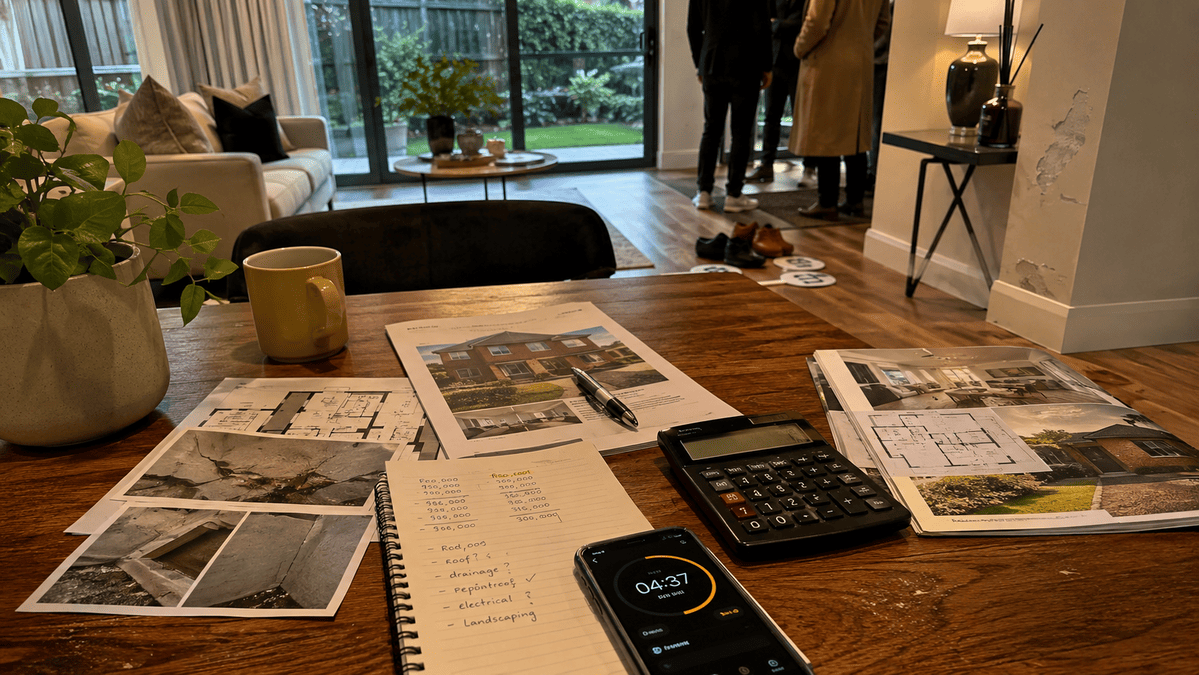
Auction environments are designed to move quickly. The countdowns, crowded inspections, competing buyers, and “you need to decide now” atmosphere can make even sensible people ignore their usual decision-making habits.
For many buyers, especially first-home buyers, the pressure is not just financial. It is emotional. You finally find a property that feels right, then suddenly the clock starts ticking.
The problem is that rushed decisions often lead buyers to overlook things they normally would have questioned calmly.
That does not mean auctions should be avoided. It simply means buyers need a system for staying clear-headed before emotions take over.
At a Glance
- Auction pressure can cloud judgment and reduce careful thinking
- Emotional urgency often causes buyers to overlook risks or warning signs
- Calm buyers usually rely on preparation, not confidence alone
- Independent information helps reduce uncertainty before auction day
- Clear limits and decision rules are more useful than “gut feeling”
- A rushed decision is still a major financial decision
If you can slow your thinking down before auction day, you are far more likely to make a decision you feel comfortable with afterwards.
Why Auction Pressure Affects Buyers So Much
Buying property is already stressful. Auctions compress that stress into a short timeframe.
According to the Consumer Affairs Victoria auction guide, auctions in Victoria are generally unconditional once the hammer falls. That raises the emotional stakes significantly for buyers trying to make quick decisions.
Under pressure, people tend to:
- focus heavily on missing out
- ignore smaller warning signs
- rely too much on optimism
- assume competition means the property must be good
- stop asking practical questions
This is especially common when buyers have already spent weeks or months searching unsuccessfully.
After a while, people stop evaluating the property properly and start chasing emotional relief instead.
Humans. Spending hundreds of thousands of dollars just to avoid feeling disappointed for another weekend.
The Biggest Mistake Buyers Make Before Auctions
Many buyers believe staying calm means “being confident”.
Usually, it means being prepared instead.
Prepared buyers often:
- know their financial limits clearly
- understand the property condition better
- accept that walking away is possible
- separate urgency from importance
Unprepared buyers often:
- rely on assumptions
- rush due diligence
- hope problems are minor
- convince themselves they can “deal with it later”
That last one becomes very expensive surprisingly often.
Calm Buyers Usually Make Decisions Earlier
One of the most effective ways to reduce auction pressure is to make most of your major decisions before auction day itself.
That includes:
- deciding your financial ceiling
- reviewing documents properly
- identifying possible repair concerns
- understanding what risks you are comfortable accepting
Auction day should ideally confirm your decision, not create it.
Buyers who try to “figure it all out on the day” are usually reacting emotionally rather than thinking clearly.
Don’t Confuse Presentation With Property Quality
Auction campaigns are heavily presentation-focused.
Fresh paint, styling, lighting, landscaping, and carefully timed inspections can make properties feel more impressive than they actually are.
That does not automatically mean something is wrong. But presentation can distract buyers from practical issues.
For example:
- a beautifully styled living room may draw attention away from uneven flooring
- fresh paint can make moisture staining harder to notice
- strong artificial scents can mask damp smells
- crowded inspections reduce the time buyers spend looking carefully
This is where independent due diligence becomes valuable.
A professional pre-purchase building inspection can help buyers understand the property more clearly before auction pressure intensifies.
Not because every home is a disaster. Most are not.
But because clear information tends to reduce emotional guessing.
Set Rules Before You Attend the Auction
One of the simplest ways to stay calm is to create rules before emotions rise.
That may include:
- a maximum purchase price
- a repair budget limit
- a list of issues you will not ignore
- conditions that would make you walk away
Without pre-set rules, buyers often negotiate against themselves emotionally.
A practical example:
A buyer might initially say:
“We’re comfortable spending up to $950,000 if the property needs only cosmetic work.”
Then auction pressure kicks in:
“Maybe the cracks are probably nothing.”
“We can sort the drainage later.”
“Another $20,000 isn’t that much.”
Except it usually is.
The Fear of Missing Out Creates Bad Comparisons
Auction buyers often compare the property emotionally instead of practically.
They start thinking:
- “What if we never find another one?”
- “Everything is expensive anyway.”
- “Someone else clearly wants it.”
- “We’ve already invested so much time.”
This mindset makes buyers treat the current property as their only opportunity.
Usually it is not.
Melbourne’s market always changes. New listings appear constantly. A property feeling urgent does not automatically make it the right decision.
Buyers who stay calmer tend to compare properties rationally:
- condition
- maintenance risk
- location suitability
- likely future costs
- renovation quality
- documentation quality
Not just emotional excitement.
Bring the Decision Back to Facts
When buyers feel overwhelmed, it helps to simplify the decision.
Ask practical questions such as:
- What do we actually know about the property?
- What are we assuming?
- What could become expensive later?
- Are we comfortable with those risks?
- Would we still feel comfortable buying this property next week?
Simple questions often cut through auction noise surprisingly well.
The goal is not to eliminate uncertainty completely. Property purchases always involve some uncertainty.
The goal is to reduce avoidable uncertainty before making a major commitment.
Fast Decisions Still Need Proper Due Diligence
Short auction campaigns can create genuine time pressure.
That does not mean buyers should skip important checks entirely.
Even under tighter timelines, buyers can still:
- review available documentation
- organise independent inspections
- speak with conveyancers or relevant professionals
- identify obvious repair concerns
- clarify unanswered questions
At NextGen Inspections, many buyers are simply looking for clearer information before deciding whether to proceed confidently, renegotiate expectations, or walk away.
That is very different from panic-buying because the auction date is approaching.
Sometimes Walking Away Is the Calmest Decision
People often treat walking away as failure.
In reality, it can be disciplined decision-making.
If a buyer feels:
- rushed
- uncertain
- financially stretched
- uncomfortable with the risks
- unable to complete proper checks
then stepping back may be the smarter long-term outcome.
Auction environments reward emotional momentum. Calm buyers deliberately interrupt that momentum when needed.
Clear Information Reduces Emotional Decisions
Most buyers cannot remove auction pressure entirely.
But they can reduce how much influence that pressure has over the final decision.
Preparation helps.
Independent information helps.
Clear limits help.
And sometimes, having a realistic understanding of the property before auction day makes the decision much easier, whether that means bidding confidently or deciding not to proceed.
If you want clearer insight before committing to a property, organising an independent inspection early can help reduce uncertainty while there is still time to think properly. Buyers dealing with short auction timelines can also book an inspection to better understand the property before the pressure peaks.